
With the publication of Draft 0 of its BFUG Position Paper, EU.ACE presents its first comprehensive contribution to the discussion on strengthening University Lifelong Learning within the Bologna Process. The paper is intended as a discussion document and a basis for dialogue with policymakers, higher education institutions and stakeholders across the European Higher Education Area (EHEA)
For more than two decades, lifelong learning has been recognised as a core objective of the European Higher Education Area (EHEA). Yet despite repeated commitments by European ministers, implementation across the Bologna Process remains fragmented and inconsistent.
As the first public milestone of this policy initiative, EU.ACE has prepared Draft 0 of its BFUG Position Paper, From Political Commitment to Structural Implementation: Operationalizing University Lifelong Learning (ULLL) as a Fourth Key Commitment of the Bologna Process.
The paper builds on more than twenty years of Bologna policy development and argues that the challenge facing Europe is not a lack of political commitment to lifelong learning, but the absence of a dedicated implementation architecture comparable to those supporting the existing Bologna key commitments on quality assurance, qualifications frameworks and recognition.
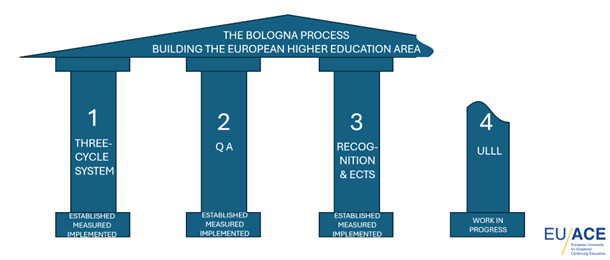
From Commitment to Implementation
Rather than proposing an additional Bologna objective, EU.ACE advocates strengthening an existing one. University Lifelong Learning should evolve from a long-standing transversal policy commitment into a dedicated implementation priority within the Bologna Process by establishing a fourth key commitment supported by appropriate governance, monitoring and peer-learning mechanisms.
Among the proposed elements are:
- establishment of a dedicated BFUG working structure on University Lifelong Learning;
- development of indicators and monitoring mechanisms;
- strengthened implementation of Recognition of Prior Learning (RPL);
- support for modular, stackable and flexible learning opportunities;
- improved permeability between higher education, vocational education and workplace learning;
- enhanced mobility and portability for adult learners; and
- structured peer learning and exchange of good practice across Europe.
Responding to Europe’s Changing Learning Needs
The position paper highlights that Europe is entering a period in which lifelong learning is becoming a structural necessity. Digitalisation, artificial intelligence, demographic change, labour-market transformation and the green transition require universities to provide flexible opportunities for continuous upskilling and reskilling throughout life.
While many higher education institutions have already expanded continuing education, micro-credentials and flexible learning pathways, current Bologna implementation mechanisms remain primarily focused on traditional degree programmes and initial higher education.
EU.ACE argues that a strengthened implementation architecture would allow lifelong learning to become measurable, comparable and systematically supported across all Bologna countries.
Supporting the Future of the European Higher Education Area
The draft also outlines illustrative monitoring areas that could build on existing Bologna, Eurostat and Cedefop data, including adult learner participation, recognition of prior learning, modular learning opportunities, transitions between vocational and higher education, and mobility for lifelong learners.
By relying wherever possible on existing monitoring structures, the proposal seeks to strengthen implementation without creating unnecessary administrative burden.
Looking Towards the 2027 Ministerial Conference
The publication of Draft 0 marks the beginning of an open consultation process. In the coming months, EU.ACE will continue refining the paper together with partners, ministries, European university alliances, BFUG stakeholders and higher education experts, with the aim of contributing to the policy discussions leading towards the 2027 EHEA Ministerial Conference.
Building on its previous policy dialogues with the European Commission, national ministries and Bologna stakeholders, EU.ACE sees this initiative as part of its long-term mission to strengthen the role of University Lifelong Learning within the European Higher Education Area.
As Europe prepares for the next phase of the Bologna Process, EU.ACE invites universities, policymakers and stakeholder organisations to join this conversation. Strengthening University Lifelong Learning through a dedicated implementation architecture is not about creating a new Bologna objective; it is about making an existing political commitment fully operational for the benefit of learners, institutions and society across Europe.